As a technical founder you need solutions that actually reduce risk now, not another plugin checkbox. Brute-force and credential stuffing attacks are automated, distributed, and designed to exploit predictable defenses. This walkthrough lays out a threat model, explains where single-purpose plugins fall short, and gives a prioritized, high-urgency plan you can implement without enterprise overhead.
- Threat model: what an attacker is trying to achieve
- Why other plugins aren’t enough
- How do you practically stop brute-force and credential stuffing?
- Tactical prioritized plan (high-urgency)
- Comparison: common plugin features vs threat gaps vs prioritized takeaways
- Operational examples and realistic configurations
- Implementation checklist — stop credential stuffing now
- Step-by-step implementation (practical)
- Tuning and false-positive handling
- Integration notes for WordPress environments
- Playbook snapshot: operator actions during an attack
- Where Hack Halt Inc. fits and how to implement
- Final priorities — what to do in the next 24 hours
Threat model: what an attacker is trying to achieve
Attackers aren’t trying to be fancy — they want valid credentials on an account with value (admin, editor, or a high-value commerce account). They use credential stuffing lists, build distributed botnets that rotate IPs and user agents, and probe for timing or behavior signals to avoid naive rate limits. Your threat model must assume attackers will:
Attack surface
Login endpoints, XML-RPC, REST authentication, and any form-based auth are all entry points. Third-party integrations that accept credentials (mobile apps, headless APIs) expand the surface. Treat all auth endpoints as public and instrumented.
Attacker TTPs (tactics, techniques, and procedures)
Common techniques include rapid credential lists, low-and-slow attempts from many IPs, replaying cookies, and submitting valid user agents to evade simple filters. They will measure which mitigations trigger and adapt accordingly.
Why passwords fail at scale
Passwords are a low-entropy control when reused. Credential stuffing leverages valid username/password pairs harvested from other breaches — so protecting the login surface is about raising attacker cost, not just blocking individual attempts.
Why other plugins aren’t enough
Most single-purpose plugins focus on one signal: rate limits, IP blocklists, or a CAPTCHA. Each of those is useful, but all are evaded by attackers who distribute attempts, route through residential proxies, or spoof browser signals. Below are practical limitations founders should expect.
Rate-limiting without context
Simple rate limits throttle by IP or username but fail when attackers spread attempts across thousands of IPs or use legitimate-looking slow retries. Rate limiting also risks locking out legitimate users if it’s too aggressive.
IP blocklists are brittle
Blocklists react to known bad IPs, but attackers rotate through fresh proxies. Blocklists also can’t distinguish between shared NAT addresses used by many users, which creates collateral damage.
CAPTCHAs and user friction
CAPTCHAs increase cost for attackers but also hurt conversion and can be bypassed by CAPTCHA-solving farms. For founder-run sites where UX matters, over-reliance on CAPTCHAs is not a sustainable defense.
How do you practically stop brute-force and credential stuffing?
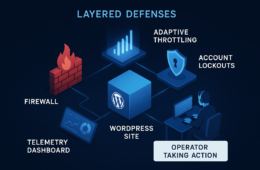
Short answer: implement layered, adaptive controls that raise attacker cost and provide operator telemetry for focused response. Prioritize defenses that are contextual (user, device, request pattern), adaptive (throttle based on behavior), and actionable (operator can isolate and contain attacks quickly).
Layered controls to deploy immediately
Combine behavioral throttling with per-account exponential backoff, limit simultaneous sessions per account, and add progressive challenge escalation for suspicious patterns. These controls make distributed attempts inefficient while minimizing false positives against legitimate users.
Telemetry and operator visibility
Instrument failed logins, unusual geolocation patterns, and device fingerprints into a lightweight operator dashboard so you can see concentrated hits and respond. For guidance on turning telemetry into concrete remediation, see the From Noise to Action blueprint.
Containment primitives
When an incident is detected, be ready to isolate: temporary IP groups, user rollbacks, forced password resets for affected accounts, and short-term stricter throttling. The Incident Walkthrough explains containment steps you can adapt for credential-focused incidents.
Tactical prioritized plan (high-urgency)
Below are pragmatic priorities arranged by how quickly they reduce risk. Execute the first two items within hours; the rest are high-priority follow-ups.
Immediate (hours): visibility and blunt containment
Enable failed-login telemetry, block obvious noisy endpoints (e.g., known abused XML-RPC paths if unused), and apply per-account exponential backoff. A simple operator rule that triples backoff after 5 failures can stop low-effort attacks immediately.
Short-term (days): adaptive throttling and behavior rules
Implement adaptive throttling that factors IP reputation, velocity, user agent anomalies, and account age. Add progressive challenges for repeated suspicious sequences so legitimate users can pass while attackers slow down.
Mid-term (weeks): automation and operator playbooks
Automate containment: when a pattern crosses thresholds, auto-isolate the affected IP range and trigger a targeted password reset for impacted accounts. Build a short playbook and practice a drill — see the operational guidance in the Operational Roadmap for containment and remediation patterns.
Comparison: common plugin features vs threat gaps vs prioritized takeaways
| Feature | Where plugins usually stop | Threat gap | Practical takeaway |
|---|---|---|---|
| IP rate limiting | Per-IP throttling or temporary bans | Fails against distributed proxy fleets and shared NAT | Layer with per-account exponential backoff and device signals |
| Blocklists | Static known-bad IPs | Reactive and easily evaded by fresh proxies | Use blocklists as one input to adaptive scoring, not a sole control |
| CAPTCHA | Stops automated form submissions | Hurts UX and can be bypassed by solver farms | Apply progressively for high-score sessions, not universally |
| Simple lockouts | Account-based lock after X failures | Can be abused to lock out legitimate users | Prefer graduated friction with operator override and watchlist |
| Telemetry-free plugins | Do not surface attack context | Operators can’t triage or tune defenses quickly | Invest in telemetry and a compact operator dashboard |
Operational examples and realistic configurations
Example: per-account exponential backoff
After 3 failures within 10 minutes, add a 30-second enforced delay for that username; double the delay for each additional failure window. This preserves usability for occasional mistakes while making large-scale attempts impractical.
Example: progressive challenge escalation
Assign a simple risk score to a session from signals (failed logins, new device, new country). At low scores allow normal login, at medium scores require 2FA or email OTP, at high scores require password reset and operator review.
Example: focused operator action
When telemetry shows concentrated hits against a set of accounts from overlapping IPs, trigger a short-term containment: isolate IP CIDRs, force password reset on affected accounts, and monitor for reattempts. The Fight Back operator blueprint provides a stepwise playbook tailored to these events.
Implementation checklist — stop credential stuffing now
- Within 1 hour: Turn on detailed failed-login logging, enable GeoIP labeling on requests, and disable unused auth endpoints (XML-RPC if unused).
- Within 6 hours: Apply per-account exponential backoff and limit concurrent sessions per account to 1–2.
- Within 24 hours: Deploy adaptive throttling rules that factor account age, request velocity, UA anomalies, and IP reputation.
- Within 72 hours: Add progressive challenge escalation (2FA / email OTP) for medium-risk sessions and test false-positive scenarios.
- Ongoing: Maintain a short operator playbook, practice a quarterly drill, and tune thresholds based on telemetry.
Step-by-step implementation (practical)
- Enable logging: ensure wp-login.php and REST auth failures are logged with timestamp, username, IP, user agent, and geolocation tag.
- Add exponential backoff: store the failure window and computed delay in a transient keyed to the username; enforce delay server-side before checking password.
- Device fingerprinting: capture a non-invasive fingerprint (screen size, accept headers, timezone) and use it to detect sudden device changes for an account.
- Progressive challenges: integrate 2FA or OTP as a secondary gate for medium-score sessions; do not present globally to avoid UX churn.
- Containment automation: implement an operator-controlled rule that, once a threshold is hit, creates a temporary firewall group and triggers password reset emails for impacted users.
Tuning and false-positive handling
Tuning is essential. Start permissive and tighten thresholds with a 7–14 day observation window. Build whitelist paths for trusted service accounts and known good IPs, and add a fast operator override that can lift aggressive controls if legitimate traffic is blocked. Use sample queries to validate:
- Query: failed logins by username over 1 hour — spot spikes.
- Query: failed login sources by CIDR — detect distributed campaigns.
- Query: new device + failed login counts — detect account takeover attempts.
Integration notes for WordPress environments
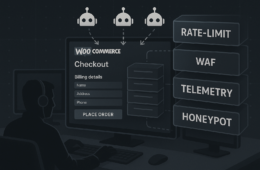
For WordPress and WooCommerce sites, be mindful of integrations: mobile apps, headless front-ends, and payment flows sometimes use API keys or tokens. Protect these by restricting token scopes and rotating them regularly. If you run WooCommerce checkouts, follow the layered-defense guidance used in our teardowns to keep malware and shells from reaching checkout flows: Fight Back: Teardown — Mistakes eCommerce Managers Make Defending WooCommerce Checkouts from Automated Abuse and Fight Back: A Tactical Teardown — Stop Automated Abuse Targeting WooCommerce Checkouts.
Playbook snapshot: operator actions during an attack
- Alert: receive spike alert from failed-login watch query.
- Assess: query top usernames, IP CIDRs, and device fingerprints hitting auth endpoints.
- Contain: apply a temporary CIDR isolate and escalate per-account backoff thresholds.
- Mitigate: require 2FA or force password reset for accounts with repeated failures.
- Post-incident: review logs, tune rules, and add detected indicators to adaptive scoring inputs.
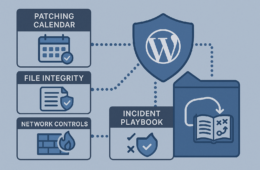
For drill templates and incident escalation examples, consult our playbooks and roadmaps on containment and hardening including the Operational Roadmap and the layered defense guides.
Where Hack Halt Inc. fits and how to implement
Founders need controls that combine adaptive controls, actionable telemetry, and simple operator controls without heavyweight operations. Hack Halt provides those layers and documentation showing exactly which settings to apply; see our internal guidance and scanner for hygiene checks. For deeper scanning and hygiene, run the WordPress Scanner and follow the remediation steps in our hardening roadmaps.
Final priorities — what to do in the next 24 hours
1) Turn on failed-login telemetry and create a watch query for rapid spikes. 2) Apply conservative per-account exponential backoff. 3) Add progressive challenges at a medium risk threshold. With those three actions you materially reduce exposure to credential stuffing while keeping control in your hands. Practice the operator steps above and run a quick hygiene scan; if you operate a WooCommerce site, also follow the teardown recommendations to protect checkouts from automated abuse.
This is a high-urgency problem with practical, prioritized controls. Focus on layered, adaptive defenses, invest in telemetry, and practice containment — those steps will stop credential stuffing campaigns and most brute-force campaigns without adding enterprise overhead.