
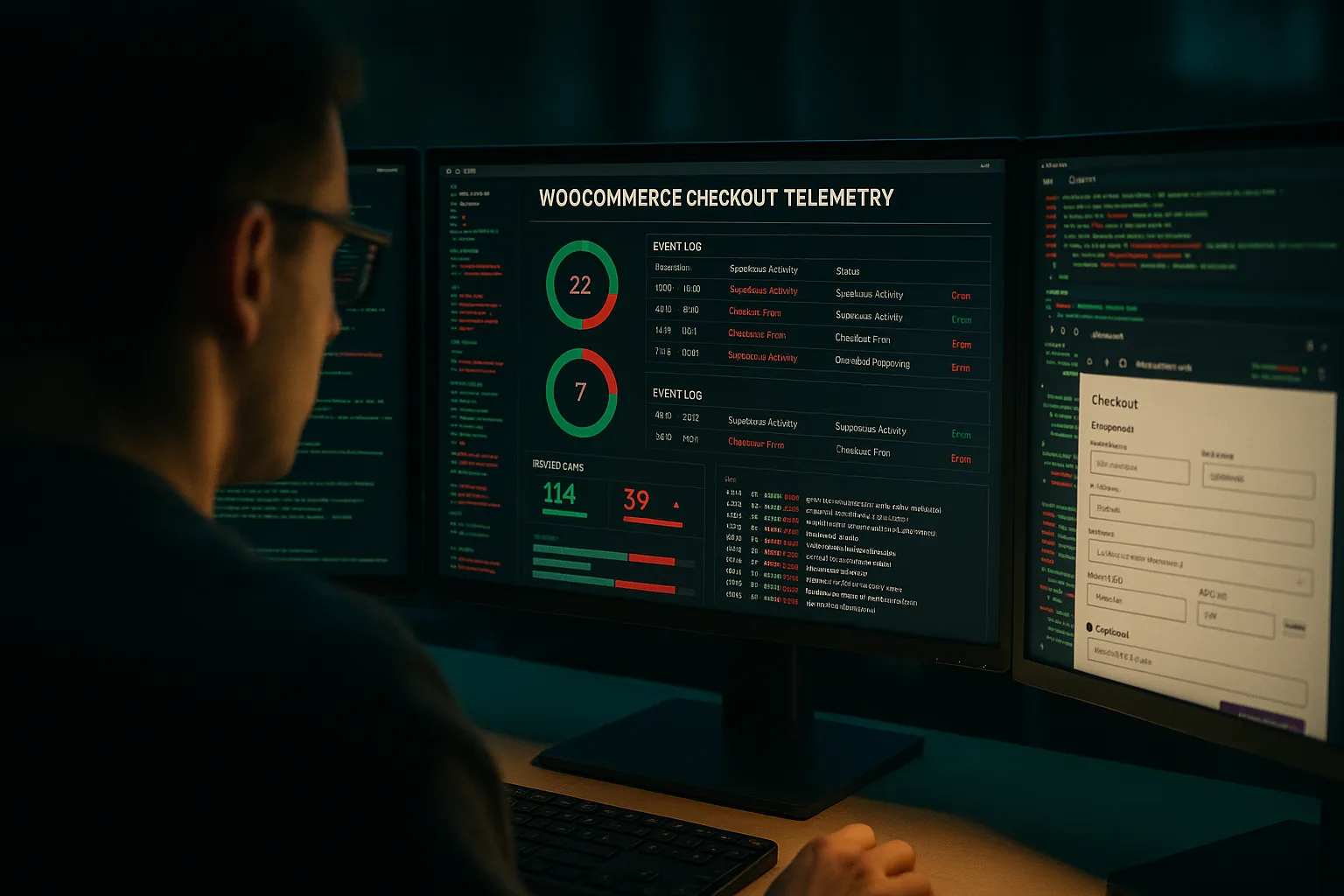
As an eCommerce manager responsible for customer payments and personal data, your checkout is both the most valuable and the most targeted surface on your site. This teardown exposes concrete mistakes teams make that let automated attackers abuse WooCommerce checkout flows, then provides operator-focused corrective actions you can apply immediately to reduce fraud, chargebacks, and data exposure.
Why automated abuse targets WooCommerce checkouts
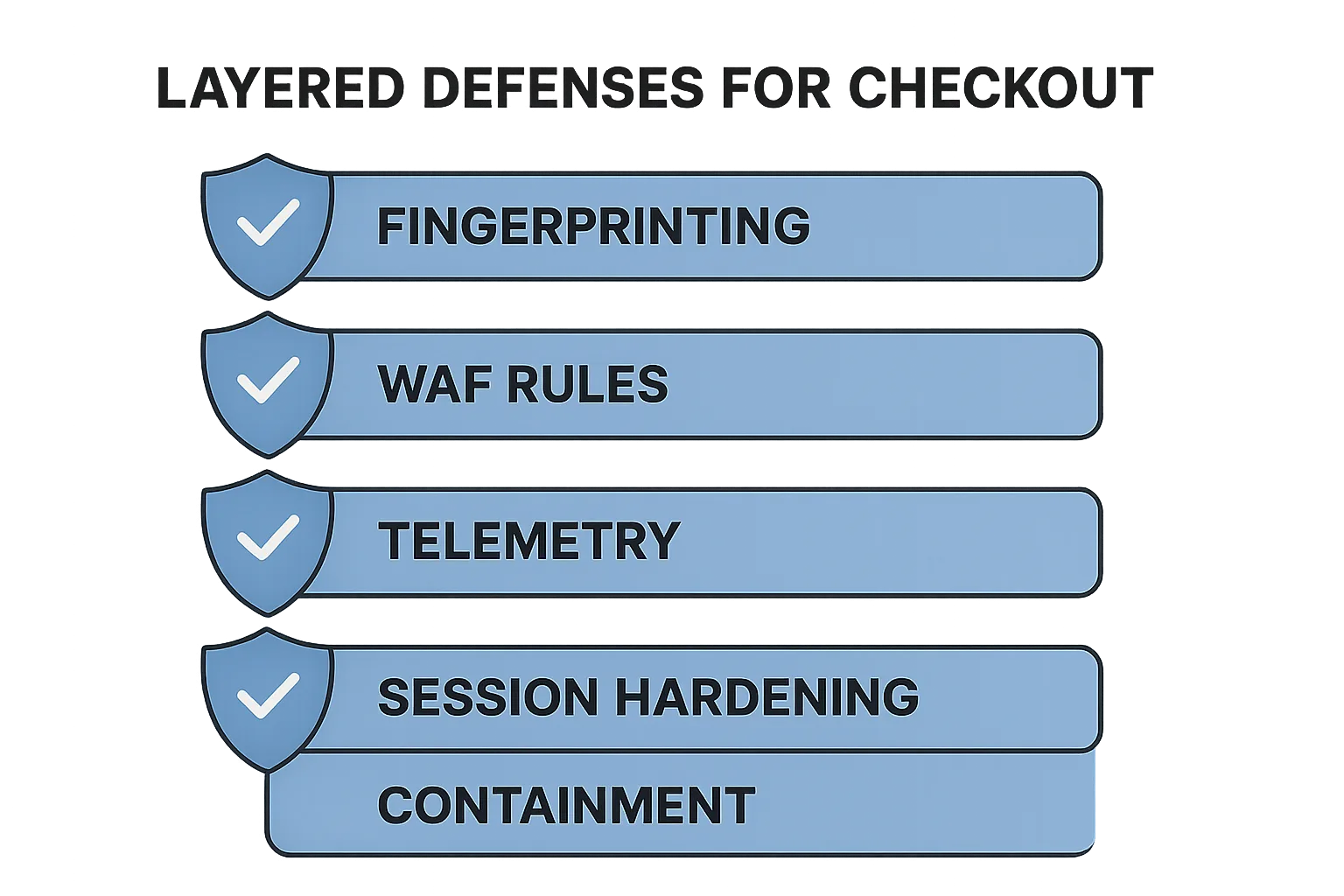
Layered defenses diagram for checkout flows
Attackers favor checkout flows because success yields payment credentials, account takeovers, or financial gain via fake orders and coupon abuse. Checkout interactions combine public JavaScript, REST endpoints, and backend order processing — multiple places where automation can probe and exploit weak validation, session handling, or telemetry gaps.
Attack surface in checkout flows
Most checkouts expose AJAX endpoints for shipping, tax, and coupon validation. Attackers script against those endpoints to enumerate coupons, check card acceptance, or bypass client-side guards. If your server trusts superficial client signals or uses predictable session tokens, automation can replay or forge requests.
What bots are after
Common objectives are: card testing (probing payment gateways with low-value charges), inventory scraping for resellers, account stuffing (creating/validating accounts to abuse loyalty), and coupon harvesting. Each objective leaves different telemetry: synthetic user agents, high request velocity, repeated failed payments, and divergent client fingerprints.
How abuse evades simple rate limits
Attackers rotate IPs, use distributed proxies, or simulate legitimate browsers to bypass naive rate limits. Relying only on IP-based throttling or a single global rule is ineffective because attackers adapt: they spread requests across many endpoints, making each origin look harmless.
Common mistakes that let automated abuse through
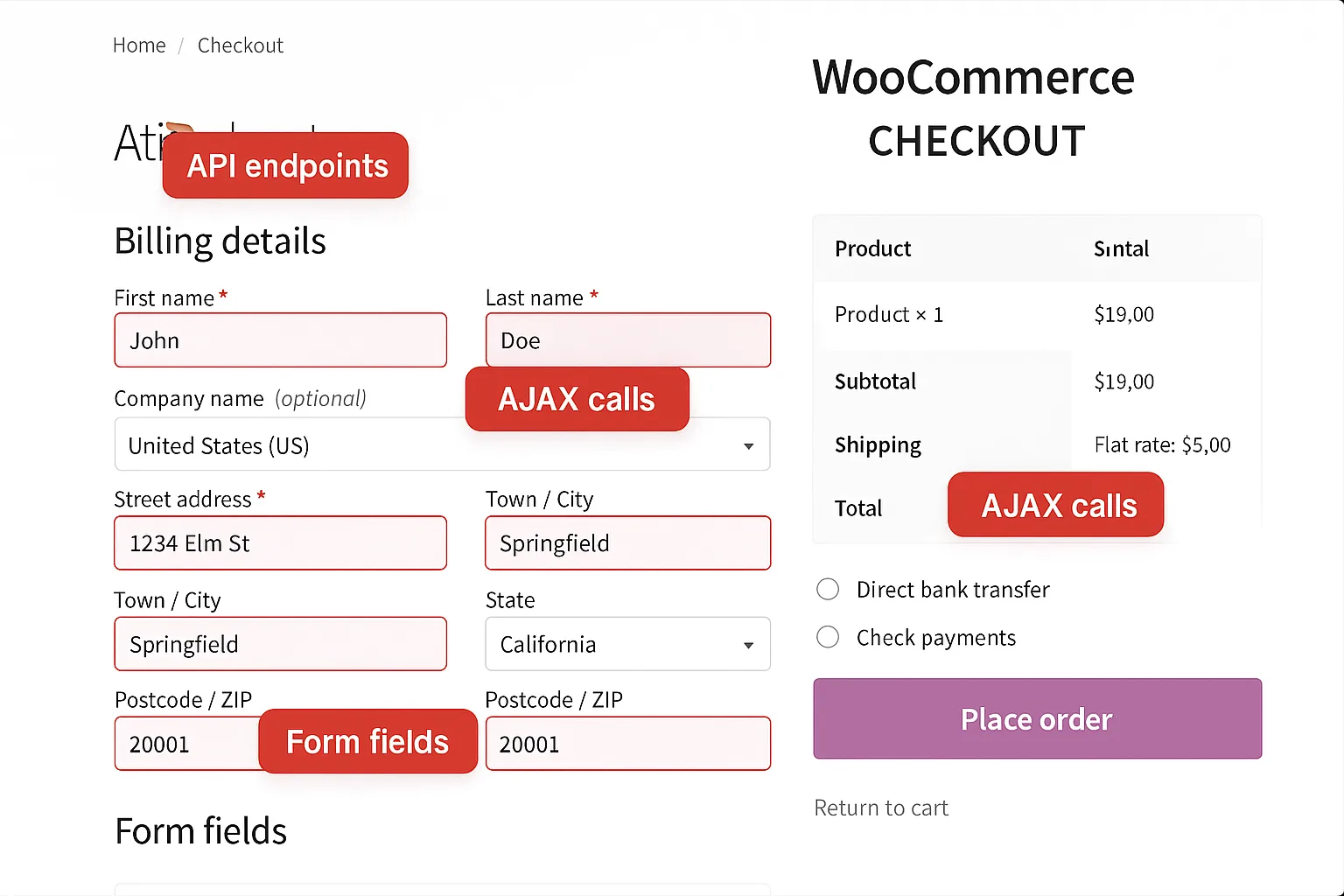
Mockup of WooCommerce checkout with attack vectors highlighted
Mistake: Trusting client-side validation as definitive
Many teams assume nonce checks or JS validations on the client are enough. They forget server-side checks and allow malformed or replayed requests. Corrective action: validate every checkout action server-side, bind nonces to session fingerprints, and reject requests with inconsistent headers or missing server-side tokens.
Mistake: Single-layer rate limiting
Applying one global rate limit or blocking by IP only will fail against distributed campaigns. Corrective action: implement layered rate controls — per-IP, per-session, per-payment-method velocity, and per-account thresholds — and make them dynamic based on behavior during the session.
Mistake: Ignoring noisy telemetry
Teams filter out ‘noise’ instead of triaging it. Those small anomalies are often the earliest signals of an evolving campaign. Corrective action: instrument telemetry to capture form submission rates, coupon validation patterns, and payment failure clustering and route alerts to a fast triage workflow so operators can escalate before damage increases. See the operator playbook for telemetry to remediation in this guide.
Mistake: Overexposing privileged endpoints
Publishing admin or management endpoints without proper privilege and origin checks creates automated entry points. Corrective action: minimize exposed endpoints, enforce strong capability checks, and isolate privileged workflows behind stricter controls. Review hardening steps in our Operational Roadmap.
Corrective actions: operator-focused fixes
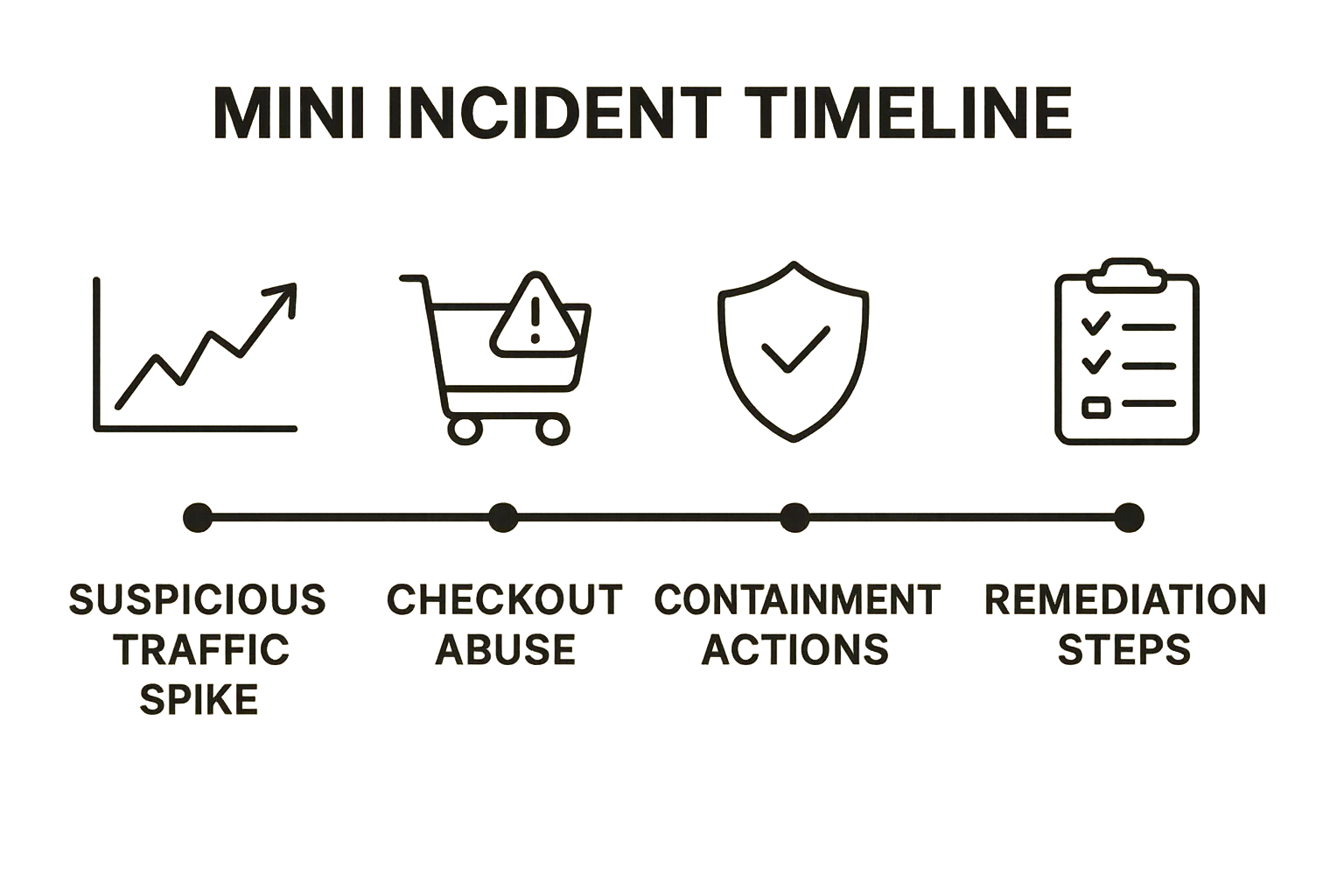
Incident timeline graphic showing detection and containment steps
Instrument and triage precise telemetry
Collect structured events for every checkout step: guest vs. logged-in, shipping lookups, coupon validations, gateway responses, and 3DS challenges. Correlate by fingerprint (device, TLS client hello patterns, behavior fingerprint) and session. Build lightweight alerts on velocity across fingerprints and cross-account anomalies so operators can quickly block or quarantine suspicious sessions. Implementing this is covered in our telemetry playbook; integration guidance is available in Hack Halt documentation.
Enforce layered fingerprinting and adaptive rules
Do not depend on a single signal. Combine short-term behavioral fingerprints (touch/scroll timing, request ordering) with server-side heuristics (failed payment rate, coupon reuse) to raise suspicion scores. Automate containment: when a fingerprint exceeds thresholds, throttle that fingerprint across the checkout subsystem and require additional challenge steps or manual review.
Harden session and payment flows
Make tokens single-use for critical actions. For example, tie a checkout nonce to the basket, user agent fingerprint, and server-side timestamp; reject requests that replay a used nonce or show mismatched fingerprints. Ensure that payment gateway callbacks revalidate order totals and shipping hashes before marking an order paid.
Operationalize containment and rollback
Create playbooks that operators can run in minutes: isolate affected sessions, cancel suspicious orders before fulfillment, and rotate any compromised API keys. Use post-incident scripts to identify impacted customers and trigger targeted communications. Our layered defense roadmap contains runbook templates you can adapt.
Quick operator checklist
- Enable structured checkout telemetry and ensure logs include request IDs and fingerprints.
- Deploy per-fingerprint throttles in addition to per-IP rules.
- Require single-use nonces for checkout and coupon redemption.
- Temporarily disable guest checkout for confirmed automated campaigns.
- Validate gateway callbacks against server-side order hashes before fulfilling.
- Prepare communication templates for affected customers and carriers.
Implementation steps: layered throttles and token hardening
- Map endpoints: list AJAX and REST endpoints used during checkout (coupon, shipping, gateway verification).
- Instrument events: emit an event for each endpoint hit with fingerprint, session ID, user agent, and result code.
- Set baseline thresholds: e.g., block or challenge fingerprint with >10 failed payment attempts in 5 minutes; throttle coupon validation if >5 validations per fingerprint in 2 minutes.
- Enforce single-use tokens: issue a nonce when the cart is created and mark it consumed on submission; reject any reuse or mismatch in basket hash.
- Automate actions: map suspicion scores to staged responses — challenge (captcha/2FA) → throttle → quarantine → cancel.
- Run tabletop drills monthly to validate operator runbooks and rollback scripts.
Example thresholds and actions
These are example, conservative values to get started — tune to your traffic patterns:
- Card testing: if a fingerprint shows >10 failed auths in 5 minutes, immediately throttle to 10% of normal throughput and require 3DS or captcha.
- Coupon abuse: if the same coupon code is validated >5 times from a fingerprint or >20 times across distinct accounts in 10 minutes, mark the coupon for temporary disable and alert ops.
- Account stuffing: if >15 new accounts are created from a fingerprint or IP range within 1 hour, block further account creation and require email/phone verification.
Incident mini-case study
What happened
A mid-size store saw a sudden spike in failed payment attempts at 03:00 UTC. Attackers rotated proxies and tested dozens of card numbers per minute against the checkout API, bypassing client-side captchas by mimicking headless browsers.
How the team contained it
Operators used telemetry to correlate high-failure-rate fingerprints and applied an adaptive throttle to those fingerprints across checkout and coupon endpoints. They disabled guest-checkout temporarily, forced additional verification on affected sessions, and cancelled pending fraudulent orders before fulfillment.
Lessons learned
The root cause was insufficient server-side validation and lack of layered telemetry. Post-incident, the team introduced per-fingerprint throttles, single-use nonces tied to basket states, and a fast response page to quarantine suspect checkouts.
How do you detect and stop automated abuse now?
Start by correlating checkout events into a single risk score per fingerprint and session, then enforce adaptive containment when that score crosses operational thresholds. Combine immediate throttles with follow-up remediation: revoke sessions, cancel suspicious orders, and harden endpoints to prevent replay.
Integrating Hack Halt into your defenses
Hack Halt Inc. provides telemetry collection, rule automation, and containment controls designed for WordPress and WooCommerce. You can use the product to implement layered fingerprinting, automated throttles, and operator runbooks that execute containment actions with one click. For implementation steps and API references consult Hack Halt documentation.
To operationalize the controls in this teardown, evaluate Hack Halt on your site and choose the plan that fits your incident response needs: Get started with Hack Halt Inc.

Further reading and operator resources
Expand your operator toolbox with these targeted guides: the full teardown for stopping automated abuse at checkout in Fight Back: A Tactical Teardown, and the hands-on playbook to defend high-value content and checkout flows at Playbook: Defend High-Value Content and Checkout Flows. Use our WordPress Scanner to surface common surface-level misconfigurations quickly.
FAQ
What immediate checks should I run after detecting checkout abuse?
Verify unusual spikes in payment gateway responses, inspect coupon validation endpoints for replay, check for repeated failed card attempts, and confirm no new admin users or API keys were created. Apply temporary throttles and escalate to containment if you see cross-account failures.
Can I automate containment without impacting real customers?
Yes — use conservative thresholds and staged actions: first throttle or require extra verification, then escalate to forced review or cancellation if behavior persists. Log each action and provide a clear path for legitimate buyers to recover their purchases.
How do I prioritize fixes vs. monitoring improvements?
Prioritize fixes that close high-confidence attack paths (server-side validation, single-use tokens, payment callback checks). Simultaneously invest in telemetry that gives you early warnings; better monitoring shortens your mean time to detect and makes other fixes more effective.
Who should be on my incident response team for checkout abuse?
Include an operator who can run containment runbooks, a payments engineer who can liaise with the gateway, a site reliability engineer to implement short-term mitigations, and a communications lead to notify affected customers if needed.
Defending checkout flows is an operations problem as much as it is a security one: automate detection, run fast containment, and close the mistakes that allow automation to succeed. When you need a platform that integrates telemetry, rules, and operator runbooks, Hack Halt Inc. offers targeted controls to help implement the hardening and remediation steps outlined here.

