Plugins that promise ‘one-click protection’ are appealing, but for WordPress site owners who don’t run a full security operations center, they’re often the first — and last — line of defense that fails quietly. This playbook explains why a single plugin is insufficient against targeted malware and web shells, and gives a pragmatic, prioritized checklist you can implement today to build a layered defense that detects, contains, and recovers from real attacks.
- Why other plugins aren’t enough
- Layered defense model (high level)
- What practical controls should you implement now?
- How do web shells get in?
- Comparison: single-plugin vs layered defense
- Actionable checklist (playbook you can run right now)
- Incident mini-case study
- Operational play: triage steps when you see a suspicious file
- How to make this sustainable without a SOC
- Where Hack Halt Inc. fits in
Why other plugins aren’t enough
Many plugins focus on signatures, IP blocking, or blocking known exploit patterns. Those controls are useful but brittle: attackers change payloads, exploiters use zero-days or valid admin sessions, and small, persistent web shells can hide in places a single plugin never expected. A resilient strategy combines prevention, detection, containment, and recovery so an incident becomes manageable instead of catastrophic.
Layered defense model (high level)
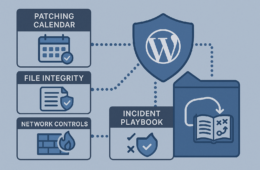
A good model separates controls into layers you can operate: perimeter, detection, host controls, admin hardening, and recovery. Each layer reduces blast radius and gives you operational signals.
Perimeter controls
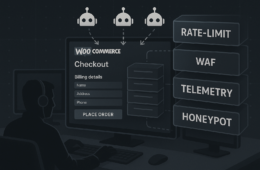
Rate limits, host-based request filters, and minimal exposure of services make exploitation harder. Where you have host or CDN controls, enforce strict allowed methods, block known bad IP ranges, and restrain access to sensitive endpoints (XML-RPC, wp-login.php) unless required.
Detection & monitoring
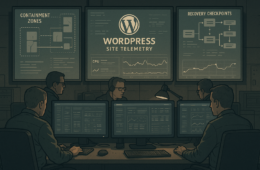
File integrity monitoring, watchlists for new PHP files, and anomaly-based telemetry (sudden spikes in file writes or unexpected cron jobs) catch the small persistent web shells that signature scanners miss. Tie alerts into a simple playbook: triage → contain → recover.
Recovery & containment
Automatic cleanup without verification is dangerous. Maintain verified backups, tested recovery steps, and the ability to quickly isolate a compromised site (read-only mode, temporary redirects, or suspending accounts) while you investigate.
What practical controls should you implement now?
File integrity and change monitoring
Record a baseline snapshot of core WP files, theme files, and upload directories. Alert on new PHP files, modified core files, or unexpectedly writable directories.
Implementation steps:
- Create a hashed baseline: run a recursive SHA-256 snapshot for /wp-admin, /wp-includes and active themes/plugins and store the manifest off-site. Compare periodically and after updates.
- Watch for new executable files in content directories. Example quick check:
find wp-content/uploads -type f -iname '*.php' -print. Schedule this to run daily and alert on results. - Flag suspicious code patterns (high-risk function calls) like
eval(,base64_decode(,gzinflate(or obfuscated strings — these are high-fidelity signals that deserve immediate triage. - Keep false-positive tuning short: add known plugin-generated files to an allowlist but log them for trend analysis.
Admin hardening and privileged workflows
Lock down admin accounts: unique admin usernames, 2FA for all privileged users, session limits, and removing unnecessary admin accounts. For step-by-step admin hardening read our implementation notes in this layered defense guide and the practical roadmap at Hardening Admin Access and Privileged Workflows.
Quick operational checks:
- List admins with WP-CLI:
wp user list --role=administrator --fields=ID,user_login,user_email. - Enforce 2FA and remove default usernames; document changes and link them into your baseline.
Hosting and file permissions
Prefer host-managed PHP users, disable public write access to code directories, and ensure uploads are segregated from executable paths. When you change host settings, document the change and record it in your operational baseline; our documentation includes procedures to map Hack Halt alerts to host-level controls.
Practical settings to apply now:
- Disable PHP execution in uploads by adding a server-level rule (Apache/Nginx) or .htaccess directive, or by the host control panel.
- Set directory permissions to the principle of least privilege: generally 755 for directories and 644 for files, with code directories owned by a non-web user when possible.
- If you must rapidly contain an incident, temporary commands operators use:
chmod -R a-w wp-content/uploads(remove all write permissions) or move a suspicious filemv wp-content/uploads/suspicious.php /root/quarantine/and setchmod 000on it.
How do web shells get in?
Web shells typically arrive through an exploitable writable path: a vulnerable plugin/theme, misconfigured upload handling, or an admin session abused by stolen credentials. Once present, a tiny PHP file (sometimes a few dozen lines) can persist and provide remote command execution or file management. Detecting small, authorized-looking changes early is critical to stopping lateral movement.
Comparison: single-plugin vs layered defense
| Control | Single-plugin only | Layered defense (recommended) | Practical takeaway |
|---|---|---|---|
| Prevention | Signatures and rules — catches known payloads. | Prevention + host filters + reduced attack surface. | Don’t rely solely on signatures; reduce exposure at the host and app level. |
| Detection | Alert on flagged files or patterns. | File integrity + behavioral signals (new PHP, cron changes, odd admin sessions). | Behavioral signals catch novel web shells faster. |
| Containment | No standard process — manual cleanup often required. | Prewritten playbook: isolate, suspend accounts, block vectors, restore snapshot. | Playbooks cut incident time and mistakes under pressure. |
| Recovery | File cleanup tools — risk of missing hidden backdoors. | Verified backups + tested restore + post-incident hardening steps. | Recovery is reliable only with tested backups and credential rotation. |
Actionable checklist (playbook you can run right now)
Use this prioritized checklist as your day-one playbook. Each action reduces risk and gives you clearer signals.
- Inventory: Export active plugins/themes, PHP version, user accounts, and file permissions.
- Baseline files: Create a verified snapshot of wp-content, themes, and core files for integrity checks.
- File watch: Configure alerts for new PHP files in uploads, modified core files, and added cron entries.
- Harden admin: Enforce 2FA, remove unused admins, rotate API keys, and set session timeouts.
- Host rules: Disable PHP execution in upload folders and lock down directory permissions.
- Containment scripts: Prepare one-click steps to block IPs, disable write access, and put the site in maintenance mode.
- Backups: Verify backup integrity and practice a restore to a staging environment.
- Post-incident: Run root-cause analysis, close the exploited vector, and update your baseline snapshot.
- Telemetry: Prioritize high-fidelity signals (new PHP in uploads, core changes, new cron jobs) and integrate them with notifications to an on-call person or a ticketing queue.
- Plugin threat model: Periodically run a simple threat-model for critical plugins (check recent CVEs, maintain minimal plugin set). For a founder or operator walkthrough see our threat-model guides such as Reduce Plugin Exploit Risk Before Disclosure: A Founder’s Fast Threat-Model Walkthrough.
Incident mini-case study
Site: a mid-size WooCommerce store with limited dev resources. Problem: a small web shell in /wp-content/uploads/ that allowed product changes and covert admin logins. Detection: a monitoring alert flagged a new PHP file in uploads and an unusual cron job. Containment: operators immediately blocked the offending IP range, put the site into temporary read-only maintenance mode, and disabled write access to uploads. Recovery: they restored files from a verified backup, rotated admin credentials, and implemented file integrity monitoring and stricter upload rules. The site recovered without payment pages being exposed. This sequence — detect, contain, recover — is repeatable and minimizes business impact.
Operational play: triage steps when you see a suspicious file
Immediate actions
- Quarantine the file: move it out of the webroot or change permissions to disallow execution. Example:
mv wp-content/uploads/suspicious.php /root/quarantine/ && chmod 000 /root/quarantine/suspicious.php. - Block the source IP and any session IDs associated with suspicious activity. Update firewall/CDN and server-level deny lists immediately.
- Create a forensic copy of the file and note timestamps before making changes. Preserve server logs for the time window around detected activity.
- Record the exact WP-CLI and OS commands you run so actions are auditable and repeatable.
Containment
- Disable public write permissions to upload folders or temporarily move uploads to a non-executable storage location.
- Suspend non-essential admin accounts until you validate they’re clean; use
wp user listto enumerate privileged accounts and disable via WP-CLI where necessary. - Isolate integrations: rotate API keys and revoke tokens used by external services that may have been exposed.
Recovery and validation
- Restore affected files from a verified backup snapshot and verify integrity via hashes and functional tests (checkout flow, login, admin pages).
- Rotate all credentials exposed or in use by admins and integration accounts.
- Perform a post-incident hardening pass: update plugins, re-run baselines, and tune alerts to reduce noise and surface real signals.
- Document the timeline and add the incident to a lessons-learned checklist to improve future response.
How to make this sustainable without a SOC
Standardize your processes: documented baselines, automatic alerts for a short list of high-fidelity signals (new PHP in uploads, core file changes, new cron jobs), and short, tested containment scripts you or your hosting provider can run. Invest time upfront in playbook automation so you’re not improvising in an incident. For an operational mapping from telemetry to remediation, see our playbook on turning noisy telemetry into concrete actions at Turn Noisy WordPress Security Telemetry into Concrete Remediation Actions.
Operational tips for small teams:
- Automate daily integrity checks and push alerts to email or a ticketing system rather than only to dashboards.
- Run quarterly restore drills: restore a backup to staging and run smoke-tests for critical flows (login, checkout, content publish).
- Keep a short, versioned incident playbook that any engineer or host support can follow; include commands, contact points, and rollback steps.
Where Hack Halt Inc. fits in
Implementing these controls is straightforward with the right tooling and playbooks. Hack Halt Inc. provides monitoring, change detection, and playbook automation that map directly to the steps above — from file integrity alerts to quick containment actions. Start a trial or learn pricing to deploy these controls faster at Hack Halt Inc. pricing. For setup and feature references, consult the Hack Halt documentation.
Wrap-up: treat plugins as one tool among many. Prioritize a layered approach: reduce exposure, boost detection fidelity, and standardize containment and recovery. The next time you see a tiny PHP file where it shouldn’t be, you’ll have a clear, repeatable playbook to stop it from becoming a full compromise.