This teardown is written for eCommerce managers responsible for WooCommerce checkout and customer data. It focuses on operator-level mistakes that let malware and web shells reach payment flows, and gives corrective actions you can implement immediately to build layered defenses that reduce dwell time, limit blast radius, and protect cardholder data.
- Why web shells matter for WooCommerce operators
- What operators get wrong: five mistakes that lead to malware persistence
- How do you verify an active infection?
- Layered defenses — a tactical operator roadmap
- Operational detection patterns and realistic examples
- Incident mini-case study: rapid containment saved the checkout
- What to change in your daily operations
- Where to learn more and operator resources
- Final checklist before leaving the incident room
- Frequently asked questions
Why web shells matter for WooCommerce operators
Web shells are lightweight backdoors that let an attacker run arbitrary commands through PHP endpoints. On a WooCommerce store, a simple web shell can read order tables, scrape saved payment metadata, install payment-skimming code, or create admin users to maintain access. The problem compounds when operators rely on one control — for example, a single endpoint firewall or a plugin scanner — and assume that prevents compromise.
Common operator assumptions
Operators often assume: plugins catch everything, file changes are harmless if timestamps match, or alerts labeled “low severity” can be ignored. Each assumption is an opportunity for malware to persist.
Why layered controls reduce risk
Layering compensates for failures: file integrity monitoring alerts you to dropped web shells, outbound telemetry flags data exfiltration attempts, and hardened admin workflows prevent privilege escalation even if a shell exists.
Where to start right now
Start with detecting anomalous file additions under wp-content/uploads and plugin directories, logging PHP process network activity, and enforcing least privilege for admin accounts. These are operational changes you can implement without changing the storefront UX.
What operators get wrong: five mistakes that lead to malware persistence
Mistake 1 — Treating plugin vulnerability as a single point to fix
Operators often patch the vulnerable plugin and assume the incident is over. In reality, attackers frequently drop backdoors first. Always check for unknown PHP files and modified core/plugin files before declaring a site clean. For practical guidance see Reduce Plugin Exploit Risk Before Disclosure: A Battle-Tested Checklist Playbook.
Mistake 2 — Relying only on signature-based scanners
Signature scanners miss obfuscated shells and chained payloads. Use behavioral indicators (unexpected PHP execution in uploads, outbound calls from PHP) and timeframe correlations to find stealthy implants.
Mistake 3 — Not segregating monitoring and recovery duties
When the same person who deploys changes is the only one who investigates alerts, human error delays response. Create distinct roles and reversible actions so containment steps (maintenance mode, credential rotation) are executed immediately and consistently. See operational playbooks at Operator Notes: Reduce Incident Blast Radius with Monitoring and Recovery Playbooks.
How do you verify an active infection?
Run all three checks: 1) scan for newly created or modified PHP files in upload and plugin folders, 2) inspect web server logs for suspicious POST requests or encoded payloads, and 3) verify outbound connections initiated by PHP processes to unknown destinations. Correlate these findings with recent plugin updates and admin activity to build a timeline.
Layered defenses — a tactical operator roadmap
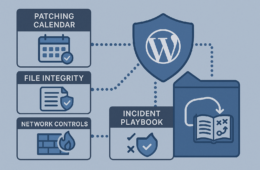
Below are layered controls prioritized for eCommerce operation teams. Each layer reduces reliance on the others and gives you multiple ways to detect or stop web shells from accessing checkout flows.
Layer 1 — Hardening and least privilege
Limit admin accounts to only the permissions they need. Enforce strong 2FA for all admin and shop manager accounts, and remove inactive users promptly. For a focused implementation roadmap, consult Hardening Admin Access and Privileged Workflows: A Practical Roadmap for IT Operators.
Layer 2 — File integrity and upload controls
Monitor file creations and modifications in wp-content, treat any new PHP in upload directories as high-priority, and quarantine automatically when feasible. Implement strict upload allowed-types and scan uploads asynchronously before they become publicly accessible.
Layer 3 — Endpoint telemetry and outbound controls
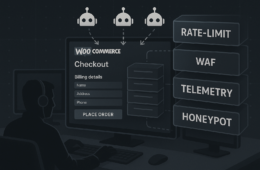
Log and alert on PHP processes making unexpected network connections or spawning shell commands. Block known bad destinations at your network edge and treat outbound anomalies as high-fidelity indicators of compromise.
Layer 4 — Recovery and blast-radius reduction
Maintain immutable backups and tested recovery scripts. If you find a shell, isolate the environment, rebuild from a verified backup, rotate all secrets, and only reintroduce code after a validated review. See recovery playbooks at Reduce Incident Blast Radius with Monitoring & Recovery Playbooks.
Operational detection patterns and realistic examples
This section gives concrete detective work patterns you can add to your runbooks and monitors right away.
Suspicious file patterns to alert on
Alert on PHP files with random filenames, files in wp-content/uploads ending with .php, or files that include base64_decode combined with eval or assert. Don’t ignore files with valid-looking names — attackers often mimic theme or core names.
Log-level indicators
Watch for POST requests containing encoded payloads, unexpected admin-ajax calls from anonymous IPs, or repeated 200 OK responses for what should be 404s. Correlate these with new file timestamps to detect drops in near real-time.
Behavioral anomalies
Spike in outbound DNS queries or HTTP requests originating from PHP-FPM processes, new cron entries, or unexplained changes to .htaccess should escalate to incident response immediately.
Incident mini-case study: rapid containment saved the checkout
Scenario: A site received a plugin update that contained an exploit. The attacker dropped a tiny web shell into wp-content/uploads and scheduled a cron job to exfiltrate order metadata nightly. What went wrong: the operator patched the plugin and disabled the vulnerable feature, but did not search uploads or check scheduled tasks. What fixed it: an integrity alert for a new PHP file triggered a follow-up that found the cron and outbound requests. The operator placed the site into maintenance mode, revoked API keys, quarantined the file, and rebuilt the checkout plugin from a verified source. Customer data exposure was avoided because outbound connections were blocked and backups were intact. For playbooks to reduce this risk proactively, review Playbook: Turn Noisy WordPress Security Telemetry into Concrete Remediation Actions.
What to change in your daily operations
Make these practical changes in the next 7 days: 1) enable file-change alerts for wp-content and uploads, 2) add an outbound telemetry alert for PHP processes, 3) enforce 2FA and remove stale admins, and 4) test recovery from a known-good backup. If you want an implementation path that ties these controls directly into operational tooling, consider using Hack Halt Inc. to operationalize file integrity alerts, telemetry correlation, and recovery orchestration — see Hack Halt Inc. pricing for plans that map to these controls.
Where to learn more and operator resources
To expand these controls into a full operator blueprint, read Operator Blueprint: Defend High-Value Content & Checkout Flows from Automated Abuse and the tactical teardown at How WordPress Hacks Actually Happen: A Tactical Threat-Model to Protect High-Value Content and Checkout Flows. When you map these operator controls to product settings, consult the product documentation for exact configuration steps at Hack Halt documentation.
Final checklist before leaving the incident room
Before you close an incident: confirm no dangling admin users, validate backups work in a recovery test, rotate all secrets and API keys, and create a timeline including root cause and containment actions. Publish the timeline to stakeholders and update your runbook with any new IOCs or detection rules.
Frequently asked questions
How long after a web shell is dropped should I assume data could be accessed?
Assume immediate access. Treat any confirmed shell as a potential data-exposure event until you can prove otherwise through logs and packet captures.
Can automated scanners find obfuscated shells reliably?
Automated scanners help but are not sufficient. Combine signature scans with behavioral alerts (file creations, process network activity) and manual review for high-value stores.
What evidence should I collect before rebuilding?
Export webserver logs, PHP-FPM process lists, file change history (git or FIM), and a copy of suspicious files in a quarantined archive. Preserve timestamps and any relevant database change logs to support root-cause analysis.
How often should I test backups and recovery procedures?
Quarterly at minimum for production WooCommerce stores, with after-hours test runs for major changes. Testing proves backups are complete and uncovers configuration drift before an incident occurs.
Need a tightly integrated way to implement these operational controls? Hack Halt Inc. connects file integrity monitoring, telemetry correlation, and recovery orchestration into a single operator-focused workflow — start mapping your defenses via the product documentation and pricing plan that fits your team.