When a web shell or stealthy PHP backdoor lands on a WordPress site, a single plugin alert rarely stops the attack. Plugins can detect or block some indicators, but attackers chain evasions, persistence, and credential theft. This playbook gives site owners a pragmatic, layered checklist to detect, contain, and recover from malware and web shell attempts without a full SOC team.
- Why aren’t plugins enough?
- Layered defense overview
- Which controls catch what? A quick comparison
- What to monitor right now (practical signals)
- Actionable checklist: containment and recovery
- Incident mini-case study: fast containment prevents customer impact
- How to tune alerts so you aren’t chasing noise?
- Runbook templates and drill steps
- Where Hack Halt fits into this playbook
- Related readings and next steps
- Final notes: run this as a drill
Why aren’t plugins enough?
Plugins provide useful protections but are reactive and limited in visibility. They often miss obfuscated web shells, cannot trace lateral movements, and don’t enforce containment or recovery steps that reduce blast radius. Plugins tend to focus on single-file or signature matches; attackers use chaining (credential theft → scheduled tasks → file drop → backdoor) that requires coordinated operational controls to stop.
Layered defense overview
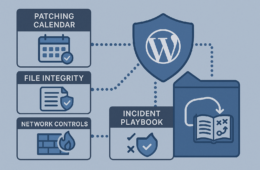
Think in tiers: prevention, detection, containment, and recovery. Each layer covers gaps left by the one before it—so even if a plugin misses a payload, monitoring and fast recovery keep the incident from becoming a breach. Embrace the principle of defense-in-depth: multiple, overlapping controls tuned to WordPress operational patterns.
Prevention: Reduce your attack surface
Start by removing unused plugins and themes, lock down writable directories, and enforce least privilege for admin accounts. Preventive measures reduce the number of vectors an attacker can use to drop a web shell.
- Audit installed plugins & themes quarterly; remove inactive items.
- Set uploads/ and cache directories to disallow PHP execution where possible (webserver config or .htaccess).
- Enforce MFA for all admin-level accounts and rotate service credentials on a schedule.
- Harden file permissions (e.g., wp-config.php readable only by the site user, www-data/chown as appropriate).
Detection: High-signal telemetry
File integrity checks, unexpected PHP uploads to the uploads folder, suspicious scheduled tasks, and unusual admin session locations produce higher-signal alerts than generic malware scans. Configure those signals and treat them as priorities.
- Record diffs with each FIM alert so remediation teams see precisely what changed.
- Correlate new PHP files with recent admin logins, plugin installs, or WP-CLI runs.
- Enrich alerts with request headers and user-agent for rapid source attribution.
Containment: Make a blast radius plan
Containment is a set of actions you must be able to perform fast: isolate the host, disable compromised user accounts, and block offending source IPs. Make these actions single-click where possible.
- Create WAF/IP rules templates for fast blocking of offending addresses or countries.
- Automate session revocation and password resets through WP-CLI or the admin API.
- Pre-create maintenance-mode assets and traffic routing rules to switch the site to a static page quickly.
Which controls catch what? A quick comparison
| Control | What it detects | Limitations | Practical takeaway |
|---|---|---|---|
| Signature malware scanner | Known payloads and common web shells | Misses obfuscated or novel shells; noisy alerts | Use with other detectors, not alone |
| File integrity monitoring (FIM) | Any new/changed files including backdoors | Requires a trusted baseline and tuning for accepted changes | High-value for early detection—baseline regularly |
| Behavioral/telemetry alerts | Suspicious admin logins, abnormal cron jobs, data exfil patterns | Needs context and correlation to reduce false positives | Prioritize as high-signal; create rapid triage playbooks |
What to monitor right now (practical signals)
New PHP files in non-code directories
Watch for PHP appearing in uploads/, cache directories, or theme and plugin uploads that normally shouldn’t accept code. Treat these as immediate alerts. Example search to find recent PHP drops:
find /var/www/example -path "*/wp-content/uploads/*" -iname "*.php" -mtime -7
Include the file owner, timestamp, and recent parent-directory writes in the alert payload.
Unexpected edits to core files
Core, theme, and plugin PHP file edits are a classic indicator. Configure integrity checks that alert on content changes and include the diff in your alert payload so you can triage faster. Example triage: check for eval(), base64_decode(), preg_replace with /e, shell_exec, or obfuscated strings.
Admin behavior anomalies
Monitor login geography, rapid privilege escalations, new admin users, and session token anomalies. These signals often indicate compromise even when file checks lag. Practical enrichment: add the X-Forwarded-For value, upstream proxy headers, and successful/failed login sequence to the alert.
Actionable checklist: containment and recovery
Run this checklist when you have a confirmed or high-confidence web shell detection. Prioritize steps you can execute with your team or automation.
- Isolate: Put the site in maintenance mode, block suspicious IP ranges at the WAF/network level, and restrict admin access by IP if possible.
- Snapshot: Take an immutable snapshot of the filesystem and a full export of logs for forensic preservation before making changes.
- Contain: Suspend compromised accounts, revoke API keys, and stop scheduled tasks that look unauthorized. Example commands: use WP-CLI to remove sessions and reset roles:
wp user session destroy --all
wp user update 2 --role=none
- Clean: Restore core and theme/plugin files from a known-good backup; remove any added PHP files found in uploads and cache after verification. Search for persistence artifacts: wp-content/uploads/.user.ini, .htaccess with PHP handlers, or cron entries in the database.
- Rotate: Rotate all admin, database, and service credentials; force password resets and revoke persistent sessions. To invalidate existing cookies quickly you can change WordPress salts in wp-config.php and restart PHP-FPM/Nginx as needed.
- Validate: Re-run file integrity checks and behavioral monitoring to confirm no persistence remains. Verify that scheduled tasks (wp_options->cron) do not include unknown hooks.
- Recover: Bring site back online in stages—static landing, then dynamic checkout—while monitoring closely.
- Document: Log timelines, root cause, and remediation steps; update controls to prevent recurrence. Preserve an evidence package: snapshots, alert JSON, diffs, and analyst notes.
Incident mini-case study: fast containment prevents customer impact
A mid-size content site detected a suspicious PHP in their uploads directory via file integrity monitoring. The operator immediately put the site into maintenance mode, took a snapshot, and removed the file; they then rotated admin passwords and restored core files from a clean backup. Because they had automated snapshots and a rapid containment checklist, customer-facing pages were restored within three hours and no data exfiltration was found in preserved logs. The operator credited preparedness—baseline integrity checks and a rehearsed containment checklist—with preventing a prolonged breach.
Technical detail: the detected file contained base64-encoded payloads and an eval wrapper. Forensically, the operator checked webserver access logs for POST requests that authored the file and found a single suspicious POST from a known bad user-agent. They blocked the source IP and audited other uploads for similar timing and strings.
How to tune alerts so you aren’t chasing noise?
Start by classifying alerts by signal confidence: new PHP in uploads = high confidence; a signature-only match = medium; one-off permission change = low. Build routing so high-confidence alerts trigger immediate containment playbooks and low-confidence go into human review. Keep a short whitelist for expected developer workflows and re-baseline after deployments.
Practical steps to reduce noise:
- Maintain a deployment tag or CI artifact list so FIM can ignore expected changes during deploy windows.
- Whitelist known developer file patterns (but require manual approval for any .php in uploads/).
- Automate enrichment: attach recent commits, deploy records, and user activity to each alert so analysts see context immediately.
Runbook templates and drill steps
Convert the checklist into a playbook with estimated timings and single-click actions. Example 30–60 minute drill runbook:
- 0–5 minutes: Triage — confirm alert, capture screenshots, and tag incident severity.
- 5–10 minutes: Snapshot — take immutable filesystem and log snapshots.
- 10–20 minutes: Isolate — enable maintenance page, apply WAF block, restrict admin by IP.
- 20–40 minutes: Contain & clean — remove malicious files, revoke sessions, restore from backup.
- 40–60 minutes: Validate & recover — run FIM, monitor telemetry, bring non-critical pages online.
Repeat this drill quarterly and after major platform changes. Track time-to-contain and time-to-recover as performance metrics.
Where Hack Halt fits into this playbook
Implementing the layered controls above is faster when detection, snapshotting, and containment actions are coordinated. For playbooks and operator-focused guides that align with these controls, see our tactical resources: Fight Back: Layered Defense Against WordPress Malware & Web Shells, Fight Back: Hardening Admin Access and Privileged Workflows — An Implementation Roadmap, and Playbook: Turn Noisy WordPress Security Telemetry into Concrete Remediation Actions. These resources show how to coordinate file integrity alerts, automated snapshots, and containment workflows so detection leads to action quickly.
Related readings and next steps
Further practical guides to harden access and reduce plugin risk can help you close upstream gaps: read our implementation roadmap for privileged workflows at Fight Back: Hardening Admin Access and Privileged Workflows — An Implementation Roadmap, and the operator-focused blueprint to defend content and checkout flows at Operator Blueprint: Defend High-Value Content & Checkout Flows from Automated Abuse. For reducing plugin exploit exposure during development and disclosure, see Reduce Plugin Exploit Risk Before Disclosure: A Founder’s Fast Threat-Model Walkthrough.
Final notes: run this as a drill
Turn this playbook into a 30–60 minute drill you execute quarterly: validate baselines, fire a simulated new-PHP alert, and walk the containment steps. Repeat until the team can snapshot, contain, and restore within your recovery time objective. Preparedness reduces blast radius; plugins help, but only layered processes win. Adopt this layered defense wordpress malware approach as an operational standard and you’ll dramatically reduce both detection-to-remediation time and the likelihood of customer impact.