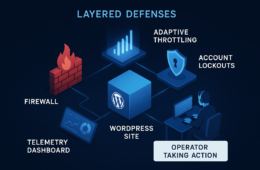
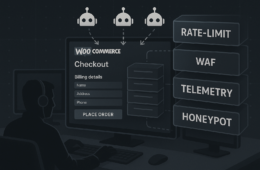
As a technical founder, you don’t have time for theoretical fixes or dashed hopes from “security by checkbox” plugins. Credential stuffing and brute-force attacks are automated at scale, adaptable, and cheap for attackers; many popular WordPress defenses address symptoms, not the attacker’s tradecraft. This tactical brief walks a focused threat model and gives prioritized, implementable controls you can apply today to stop automated login abuse without enterprise overhead. If your goal is to stop credential stuffing WordPress sites effectively, treat these steps as a short operational playbook rather than optional hardening tips.
- Threat model: what the attacker actually does
- Why other plugins aren’t enough
- How do you stop credential stuffing and brute-force without enterprise friction?
- Tactical controls — prioritized, practical, and low-friction
- Comparison: common plugin behaviors vs. what you actually need
- Operational examples and realistic configurations
- Implementation checklist — step-by-step
- Example detection thresholds and playbooks
- Post-incident checklist
- Where Hack Halt Inc. fits in
- Final priorities — what to do first
Threat model: what the attacker actually does
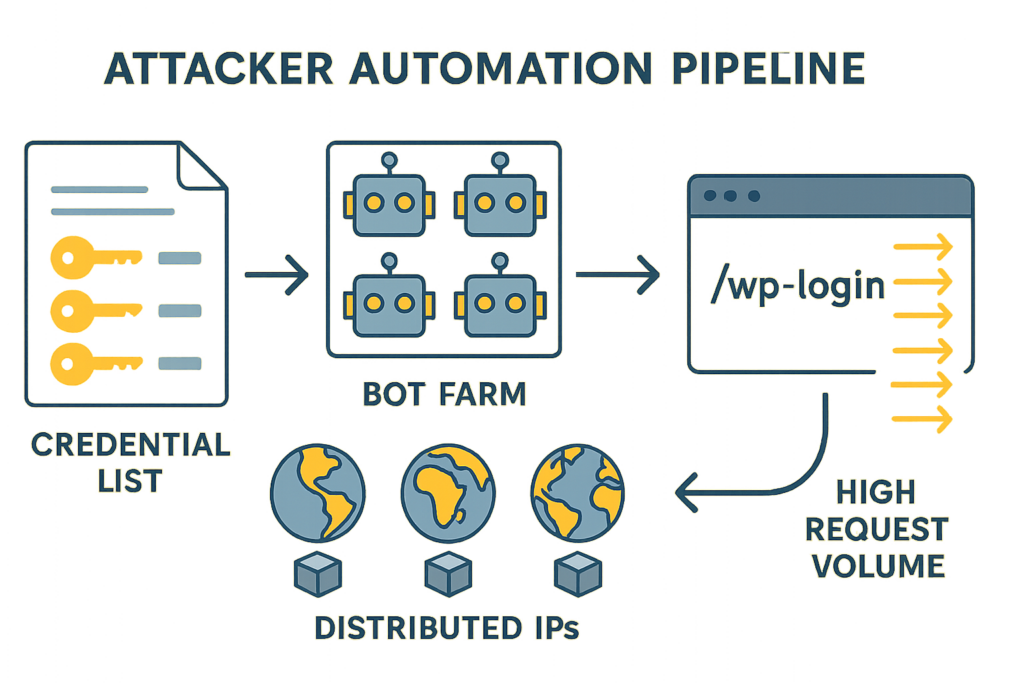
Diagram of credential stuffing automation pipeline targeting wp-login
Credential stuffing and brute-force attacks are automation-first problems. Adversaries chain three resources: lists of username/password pairs, low-cost compute (bot farms or compromised residential IPs), and orchestration that randomizes patterns to evade simple rate limits. The goal is access, not noise: once a single high-value account is compromised, escalation and data theft follow quickly.
Common attacker tactics
Attackers rotate IPs, vary user-agents, and simulate human timings; they will retry slowly if aggressive blocking is in place. They test many credentials per minute from thousands of endpoints, then pivot to accounts that show success.
Why scale matters
A local rate-limit that blocks after 5 attempts will slow a small attacker but does not stop a distributed campaign. Defenses must assume a distributed, adaptive opponent and raise the cost per successful login dramatically.
Why other plugins aren’t enough
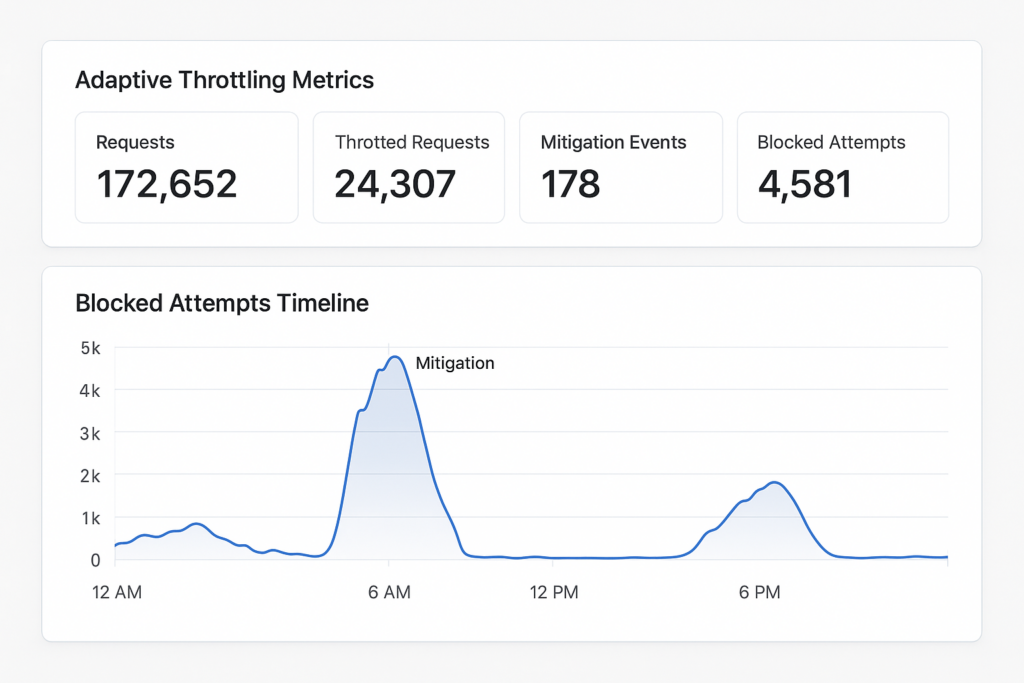
Adaptive throttling dashboard showing blocked login spikes
Many WordPress plugins provide one-size-fits-most features: basic login throttling, simple IP blacklists, or cosmetic login form tweaks. Those controls reduce noise but fail when attackers scale and adapt. The difference between nuisance reduction and true mitigation is the ability to: (1) correlate signals across requests, (2) apply adaptive throttling and fingerprinting, and (3) convert telemetry into fast containment and remediation.
Limitations you’ll see in the field
IP-based blocks are brittle (proxies, rotating IP pools); static rate limits are easy to evade with distributed clients; and UX-only changes (hide usernames, custom URLs) only slow unsophisticated bots. You need controls that combine signals — telemetry, fingerprinting, reputation — and respond with graduated measures.
Where plugins succeed and where they fail
Plugins can eliminate low-effort script noise, but they rarely offer adaptive, cross-site telemetry, automated containment workflows, or pragmatic escalation paths. For a practical operator approach, read the longer walkthrough in our foundational piece Why Other Plugins Aren’t Enough: A Threat-Model Walkthrough to Stop Brute-Force & Credential Stuffing, which outlines the full threat model and examples.
How do you stop credential stuffing and brute-force without enterprise friction?
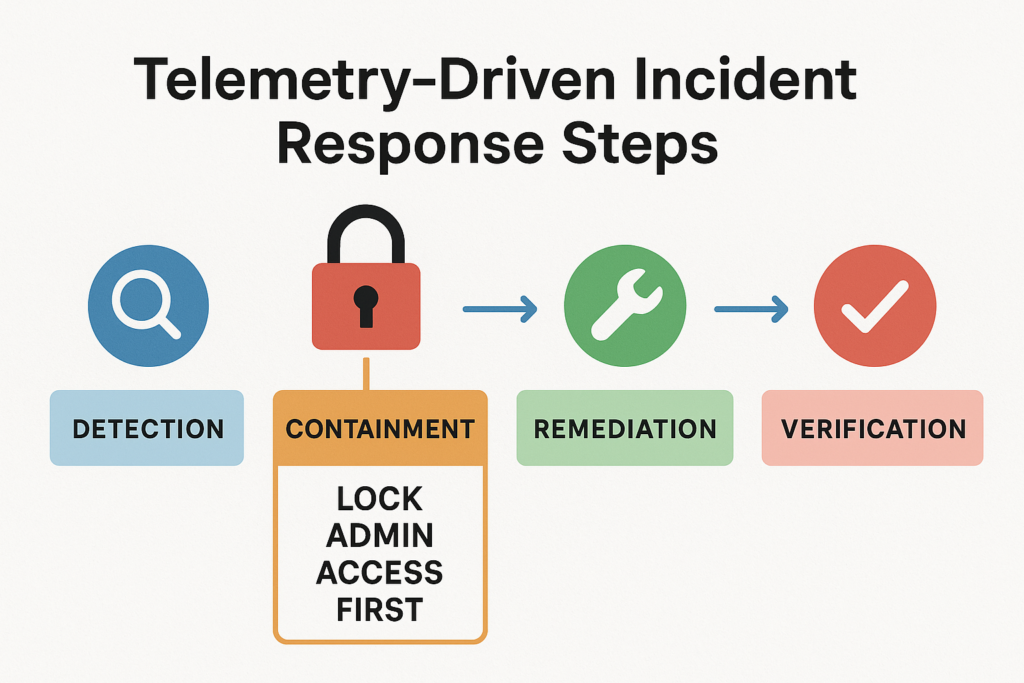
Telemetry-driven incident response timeline for WordPress
Apply signal-fusion controls (fingerprint + telemetry), enforce graduated throttling, and automate containment of suspicious accounts; combine detection and response so low-cost attacks become operationally expensive. Implement these in prioritized order and measure the cost-per-success for attackers after each change.
Prioritization principle: raise attacker cost fast
Start with changes that increase attacker time and complexity the most for the least operational overhead: add adaptive throttling, require strong authentication on high-value endpoints, and ensure you can quickly lock or isolate accounts when telemetry indicates compromise.
Rapid containment over prevention-only
Assume some credential reuse will succeed. The operational win comes from fast automated containment — isolate sessions, rotate keys, and force session invalidation for affected accounts — so a single success does not lead to full compromise.
Tactical controls — prioritized, practical, and low-friction
Below are controls ranked by impact-to-effort for a small technical team. Implement them in order until the attacker’s cost is unacceptable.
1) Adaptive throttling and fingerprinting
Simple rate limits fail against distributed attacks. Use request fingerprinting (combine cookies, TLS fingerprints, header entropy, and request timing) to group requests that belong to the same logical client, then apply graduated throttling: slow responses, enforce progressively harder challenges, and finally temporary blocks. This pattern reduces false positives while raising attacker costs.
- Fingerprint signals to combine: IP, TLS client hello fingerprint, Accept/User-Agent entropy, cookie presence, request timing pattern (inter-request jitter), and JavaScript challenge tokens.
- Example policy: for a logical client with >20 failed attempts across >5 IPs in 30 minutes, escalate from 2s response delays → CAPTCHA → 10-minute temporary hold.
- Implementation tip: log raw signals in a central store (simple JSON events) so you can iterate on correlation rules without changing code paths.
2) Protect high-value entry points and sessions
Not every login is equally valuable. Prioritize MFA and session hardening for admin and high-privilege accounts, and require re-authentication for sensitive flows. Keep session timeouts reasonable and revoke sessions automatically on suspicious login patterns.
- Baseline: enforce MFA for all accounts with administrative or commerce privileges; consider progressive MFA for accounts that access billing or PII.
- Session policy example: admin sessions expire after 12 hours of inactivity; privileged API tokens rotate automatically every 90 days.
- Quick implementation: add server-side checks that invalidate WP sessions by updating the user meta session token when containment runs.
3) Telemetry-driven response and fast remediation
Collect login telemetry centrally and set concise alerting thresholds for unusual success patterns. Telemetry should inform automated responses: quarantine accounts, block offending fingerprints, and surface incidents to the operator for manual follow-up. See how to convert noisy signals into concrete fixes in From Noise to Action: An Operator’s Blueprint to Turn WordPress Telemetry into Fixes.
- Minimal telemetry fields: timestamp, username attempted, result (success/fail), client fingerprint hash, IP, user-agent, referer, and session ID.
- Alert rule example: more than 5 successful logins for different accounts from the same fingerprint within 1 hour triggers immediate review.
- Automate containment: use a queued worker to apply temporary holds and send forced-reset emails; automation reduces time-to-containment to seconds rather than hours.
Comparison: common plugin behaviors vs. what you actually need
| Control | What many plugins do | What you need (practical takeaway) |
|---|---|---|
| Rate limiting | Simple per-IP thresholds, fixed block windows | Fingerprint-based, adaptive throttling with graduated challenges and temporary holds tied to logical clients, not just IPs |
| IP blocking | Manual or static blacklists | Short-lived reputation blocks plus fingerprint correlation and automated expiry to avoid collateral damage |
| Login obfuscation | Custom login URLs, hiding admin links | Use obfuscation as a modest multiplier only — combine with telemetry and strong auth for true protection |
| MFA & session controls | Optional MFA plugins or add-ons | Enforce MFA on high-value accounts and implement automatic session invalidation on suspicious activity |
Operational examples and realistic configurations
Below are concise, realistic examples you can adopt without heavy ops overhead.
Fast win: graduated response for suspicious login patterns
Detect multiple failed attempts across many IPs for the same username within a short window. Respond with a graduated sequence: add an increasing delay to responses for that logical client, require an additional client-side challenge, then block for a short rolling window if behavior persists. This makes credential stuffing far less profitable.
Account containment workflow
On confirmed suspicious login or credential use: (1) immediately invalidate active sessions for the account, (2) force password reset for the account with a temporary hold on privileged actions, and (3) surface the event in your telemetry dashboard for operator review. Automate steps 1 and 2 to reduce reaction time.
Measuring success
Track three KPIs: successful logins per credential list, average attempts per successful login, and time from first suspicious signal to containment. Each control should move at least one KPI in the attacker-cost direction.
Implementation checklist — step-by-step
- Instrument telemetry: add a lightweight event stream for every login attempt with the minimal fields listed above.
- Build a fingerprint hash: combine stable signals (TLS fingerprint, cookie presence) and compute a hash stored with each event.
- Deploy graduated throttling: implement response delays and challenge escalation for fingerprint groups, not just IPs.
- Enforce MFA selectively: identify high-value roles and enable mandatory MFA and session hardening for those accounts.
- Automate containment: queue workers should revoke sessions, force resets, and apply temporary holds based on rules.
- Iterate thresholds: start conservative (avoid locking real users) and tighten after observing telemetry for 48–72 hours.
Example detection thresholds and playbooks
Concrete rules you can start with and tune for your site:
- Rule A (credential reuse): >= 10 failed attempts for the same username from > 3 distinct fingerprints in 15 minutes → require password change and temporary hold on privilege changes.
- Rule B (credential list hit): >= 30 failed login attempts across many usernames from a single fingerprint in 10 minutes → escalate to CAPTCHA and 30-minute hold if behavior continues.
- Operator playbook: for any Rule A or B hit, the automation should (a) quarantine the account, (b) invalidate sessions, (c) mark events for operator review, and (d) send an account-holder notification.
Post-incident checklist
- Confirm no lateral movement: check admin logs and plugin changes.
- Rotate any exposed API keys or service credentials.
- Review telemetry to find the earliest indicator and add it to detection rules.
- Update runbook thresholds and replay the incident in a sandbox to validate fixes.
Where Hack Halt Inc. fits in
If you want a focused, operationally lightweight way to implement the signal-fusion, adaptive throttling, and telemetry-driven response described above, consider using Hack Halt Inc. as the enforcement and automation layer. Hack Halt Inc. provides built-in telemetry correlation, graduated mitigation primitives, and fast containment playbooks that map directly to the techniques in this brief — see pricing and deployment options here. For a strategic baseline and longer threat-model reading, refer to our core walkthrough Why Other Plugins Aren’t Enough to Stop Brute-Force & Credential Stuffing.
For operators who want an immediate diagnostics pass, run the site scanner to locate weak authentication paths and telemetry gaps: WordPress Scanner. If your site includes checkout or high-value flows, cross-reference mitigation plans with the checkout-focused teardown in Fight Back: A Tactical Teardown — Stop Automated Abuse Targeting WooCommerce Checkouts.
Final priorities — what to do first
Start with adaptive throttling and fingerprinting, enforce MFA on accounts with elevated privileges, and automate containment flows that revoke sessions and force resets. Measure attacker cost via the KPIs above and iterate. If you need an implementation path that maps telemetry to automated mitigation without vendor ambiguity, Hack Halt Inc. offers direct controls to implement these mitigations quickly; see the operator blueprint at Fight Back: A Step-by-Step Operator Blueprint to Stop Brute-Force & Credential Stuffing.
Attackers will keep evolving — your defense wins when you prioritize signal fusion over one-off fixes, automate containment, and continuously measure the cost you impose on the adversary. Start with the highest-impact controls outlined here and iterate from there. If your short-term goal is to stop credential stuffing WordPress campaigns with minimal operational overhead, begin by instrumenting telemetry and deploying fingerprint-based throttling this week — then add automated containment and MFA over the next sprint.